
Science Made Silly
Updated: Jun 22
This 2008 Japan Times column came to be because I kept running across online stories aimed at bizarre Japanese scientific research.
Not that Japan shies from the bizarre. From wild game shows to maid cafes to capsule hotels to high-tech toilets and more — in certain respects, Japanese culture flies beyond the rainbow, way, way up high.
Even Homer Simpson knows this. Duuh. In 1999, The Simpsons aimed an entire episode at Japan and its weirder echoes.
No other notes. This is all true and all straight forward. My title: "Science Made Silly." Read The Japan Times title below.

Research on Some Research
Mar 29, 2008
Most of my Stateside family and friends have knowledge of Japan only as deep as what they see on TV.
Which means they think I live my life in a dizzy world of ninja, yakuza and robots.
And for the web-surfers out there, the impressions can be even dizzier. For have you read the news about Japan lately? I mean the "research" news — those tantalizing tech tidbits that pop up on Internet sites.
Item: Scholars at the University of Tokyo have discovered that drinking makes people sorrowful. Not that they did this sobering research themselves. No, their conclusion came after an intense examination of inebriated mice.
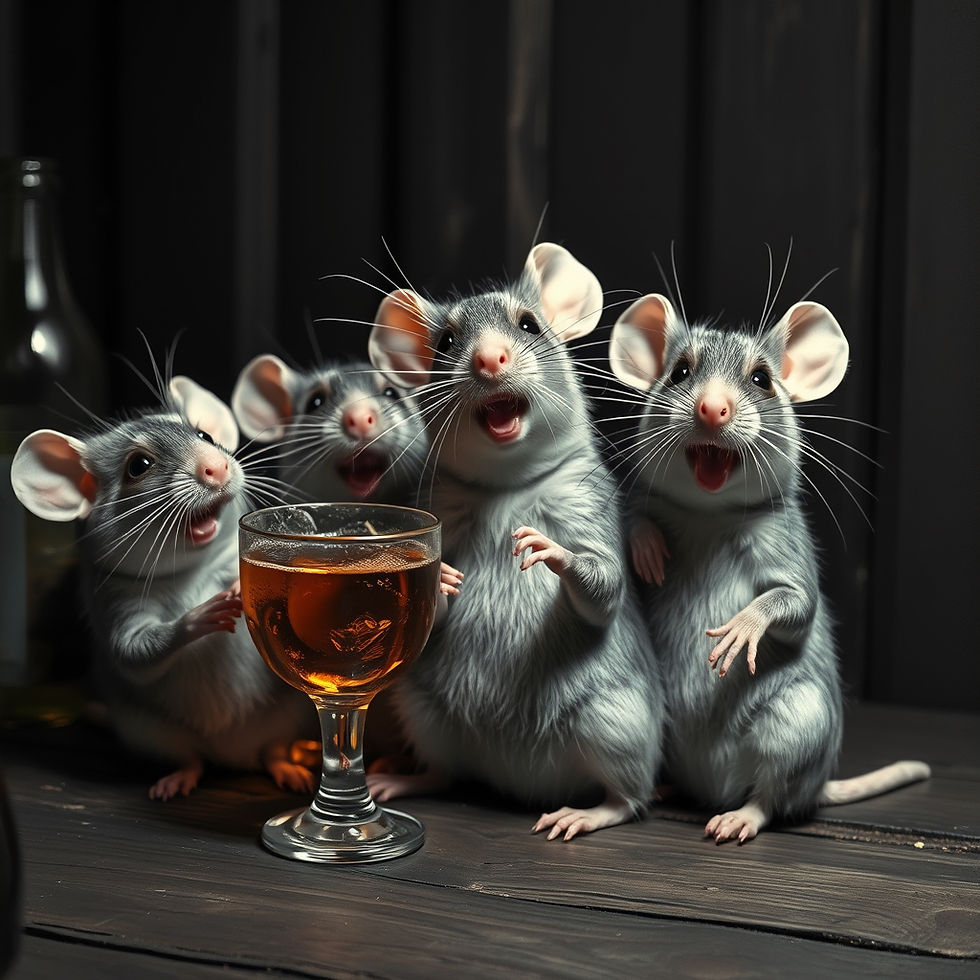

Item: Others at the same University of Tokyo have created
mutant mice that have no fear of cats. These mice no longer smell cats as predators. Too bad the cats can still smell them as lunch.
Item: At Kyushu University, researchers have discovered that eating yogurt will help people retain their teeth longer than those who don’t eat yogurt. I imagine they gleaned this info by spooning yogurt to mice.

Item: Suntory, Ltd. announces plans to market blue roses, a flashy but unnatural bit of botany first developed in 2004. Not so oddly enough, Suntory also sells whiskey, the drinking of which can result in a sorrowful mood, perfect for a blue rose. All perhaps coordinated with tipsy mice.

Item: NHK reports Japanese scientists have invented a wasabi spray that can awaken the hearing-impaired during emergencies, when other alarms might not.
Personally, I would not wake up for wasabi. Pizza, of course. Brownies, sure. Yogurt? Well, why not? I can escape fire and have healthier teeth at the same time.
Item: Scientists at Japan's National Institute of Agrobiological Sciences have figured out how swallowtail caterpillars disguise themselves as bird poop. This has clear implications for soldiers and the future of camouflage.
Item: NTT Docomo is developing a new smartphone that will tell you when your breath is bad. Next in line is perhaps a phone to say you're fat and ugly.
Just how has Japan come to corner the market on oddball research? Isn't this the cyber center of the modern world? Why aren't we reading about nuclear fission made from soy sauce or machines that zap you to work via email rather than by train?
One friend offers this threadbare hypothesis:
Most researchers in Japan are under the thumbs of senior colleagues, few of whom will risk their reputations by breaking fresh scientific ground and perhaps tripping in the subsequent hole. Younger scholars dare not challenge anything significant, and thus, rather than earth-changing, big-scale progress, we end up with small-scale Internet news bites.
"So what?" says my wife. "I like to see my country's name in print. It makes me feel proud. Japan is clearly on the cutting edge."
But on the cutting edge of what? Absurdity?
The bigger question is why doesn't Japan dominate the Ig Noble Awards — those Nobel Prize take-offs handed out at Harvard each year by the Annals of Improbable Research magazine. One would guess Japan would kick butt there the way the Chinese do in ping pong.
However, Japan has claimed only a dozen Ig Nobles since the ceremony began, 16 years ago. A modest amount, although more than Japan's genuine Nobels.
But most of the Ig Noble winners are lulus.
Like the 1995 award in Psychology, in which Keio University researchers taught pigeons to distinguish between the works of Monet and Picasso.
Or the 1997 prize in Biology for the Kansai Medical University of Osaka, in which researchers measured people's brain waves while they chewed different flavored gum — investigations so encompassing they were conducted together with researchers in Switzerland and Prague.
Or the 1999 award in Biology, won by the Safety Detective Agency in Osaka for the invention of a spray to check a husband's underwear for signs of infidelity.
Or the 2003 award in Chemistry to Yukio Hirose of Kanazawa University, who studied why pigeons prefer to poop on some statues more than others.

Or the 2005 award in Nutrition to Dr. Yoshiro Nakamatsu, who photographed his every single meal for 34 years and then shared those pics with the world. There’s the book for your coffee table.
Or the 2007 award in Chemistry to scientist Mayu Yamamoto, who somehow succeeded in extracting vanilla flavoring from cow dung. One wonders what she could do with other animals.
One also wonders about future such studies. What might come next? Cow dung drawn from vanilla? Or pigeons that can distinguish between bird poop and caterpillars?
It may be science, but it's still unbelievable. Ninja, yakuza and robots are somehow easier to live with.
Quick postscript: In the ensuing 18 years since this column's publication, Japan has picked up the pace in securing both Nobel and Ig Nobel prizes. The totals for each are running almost neck-and-neck, with Japan quite proud of all winners.
Following are a few of Japan’s zanier Ig Nobel prize awards since 2008…
The 2014 award in Physics to Dr. Kiyoshi Mabuchi, et al, for studying what makes banana peels slippery.
The 2016 award in Perception to Atsuki Higashiyama and Kohei Adachi for analyzing why things look differently when you view them while bent over with your head between your legs. (Something I’ve always yearned to know.)

The 2020 award in both Acoustics and Medicine to Takeshi Nishimura, et al, for getting alligators to vocalize while breathing helium. (It doesn’t say what they had them vocalize. “Crocodile Rock?”)
And last, the 2025 award in Biology to Tomoki Kojima, et al, for discovering that painting black-and-white stripes on cows will protect them from horseflies. (Might work on humans too. If you have a horsefly problem, try going zebra.)

© Thomas Noah Wood
All website images are either from Unsplash, AI image creation software provided by the Wix platform, or from Thomas Noah Wood himself.
Enjoyed this? New columns post free, twice monthly — subscribe here to get them by email. Look to the bottom of the page.
If you'd like more of my writing, my two ebooks — The Keeper of Dragonflies and Chop-Chop the Killer Whore — are available on Amazon.
Want to read more? Click "Blog" on the menu bar for the full archive.


Comments